A large reasoning model can answer product questions well—and finish after the conversation has moved on.
LiveThinking addresses this in two stages. Rejection Sampling Fine-Tuning (RFT) transfers capability to a compact model. GRPO then makes its reasoning shorter without sacrificing correctness or helpfulness.
A short comment may depend on the current product, an earlier turn, and retrieved documents. Reasoning helps combine that evidence, but its duration must fit a live conversation. The internal trace also needs to stay separate from the short response spoken by the avatar.
LiveThinking first transfers product-answering behavior to a compact student, then uses RL to reduce unnecessary reasoning while retaining response quality. The budget is chosen for real-time commerce; other tasks may need different reasoning lengths.
Correctness and helpfulness
Responses are evaluated along two dimensions using LLM-as-a-Judge:
Correctness (C)
Measures factual alignment with product knowledge:
A correct reply must have every claim supported by documents
Helpfulness (H)
Optimizing correctness alone can encourage minimal, cautious replies that avoid errors without giving the viewer enough help. We therefore score helpfulness separately.
To counteract this tendency, we introduce Helpfulness as a complementary metric. It incentivizes the model to provide richer, more valuable information, striking a balance between accuracy and utility:
A response is considered helpful if, in addition to correctly answering the query, it proactively offers supplementary, relevant information from the documents that anticipates and addresses the user’s implicit needs within the conversational context (
LLM Judge validation
We calibrated the Judge against several hundred human-labeled replies before using it in training or data production. Two annotators scored each reply for correctness and helpfulness; disagreements were excluded, and each task’s positive and negative labels were balanced to 1:1. Refining the judging prompt brought agreement to 83% for correctness and 84% for helpfulness. Later automatic scores remain subject to this evaluator’s reliability, including on ambiguous cases.
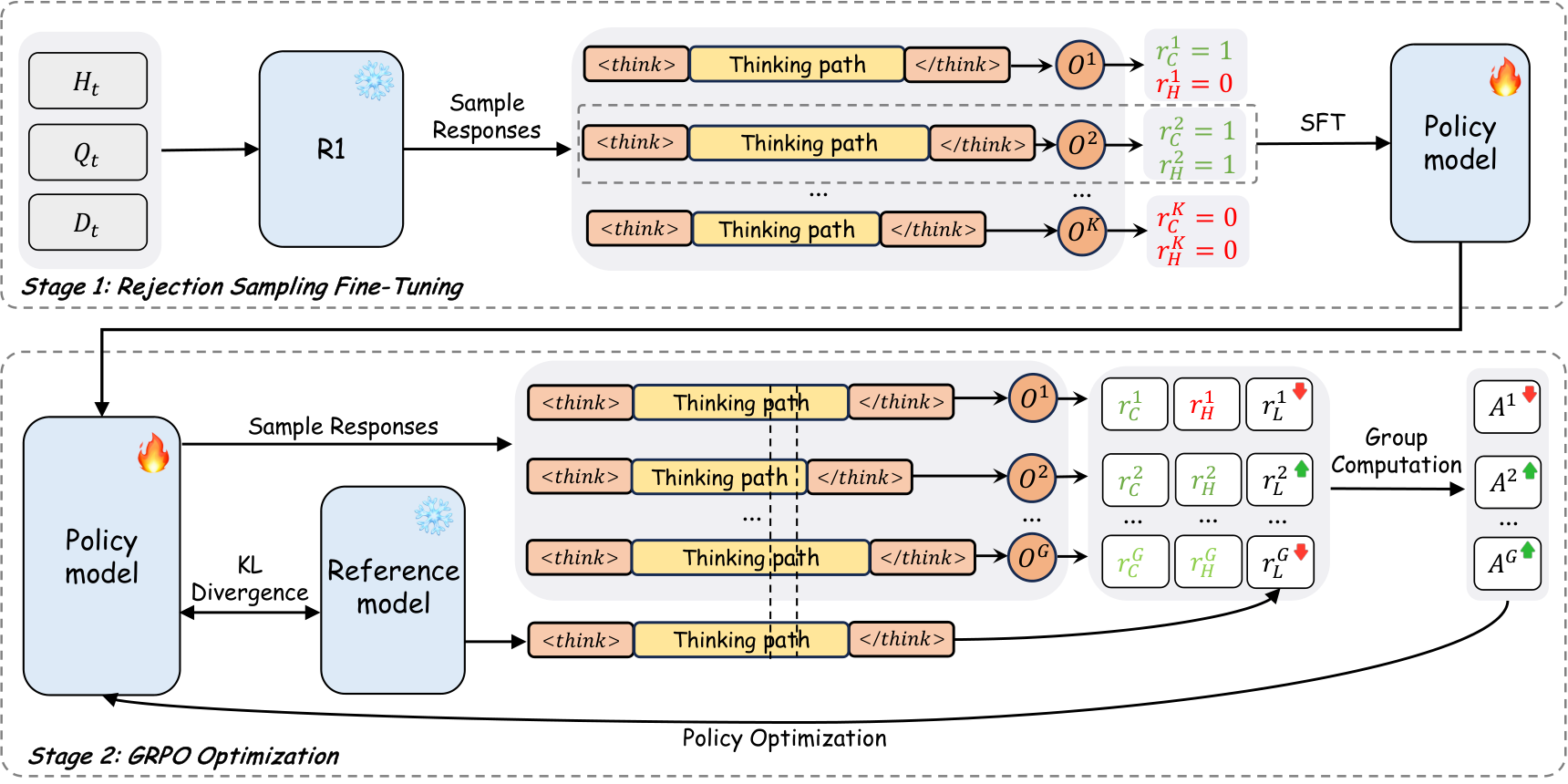
Trajectory distillation and RL
Our two-stage methodology first distills e-commerce reasoning ability into a lightweight model via RFT. Subsequently, we employ GRPO to compress the model’s reasoning path, optimizing for efficiency while maintaining response quality.
Rejection sampling fine-tuning
To transfer capabilities from the 670B reasoning MoE teacher model (37B activated parameters) to the lightweight student model, we employ a three-stage distillation pipeline formalized as:
Teacher-generated data
We start with the unlabeled commerce corpus
LLM Judge filtering
DeepSeek-R1 filters teacher trajectories using the correctness and helpfulness criteria above. Only examples passing both checks enter student training.
For input
where
MoE student fine-tuning
Since our student model
The main task loss
where the input
Reasoning quality and length
While RFT (as detailed in §4.1) transfers knowledge, it also inherits the teacher’s verbose reasoning. We address this using RL to optimize for reasoning efficiency, correctness, and helpfulness.
RL formulation
We frame response generation as a Markov Decision Process (MDP). The state
Reward design
Now we need to shorten generation without losing the behavior we just taught. We use three rewards together: length tracks generation cost, correctness checks product facts, and helpfulness checks whether the reply meets the viewer’s need. Each addresses a different shortcut. A policy that says little can avoid factual errors; a policy that answers quickly can also stop before checking the evidence. Keeping all three signals in the loop makes those trade-offs visible during training rather than only after deployment.
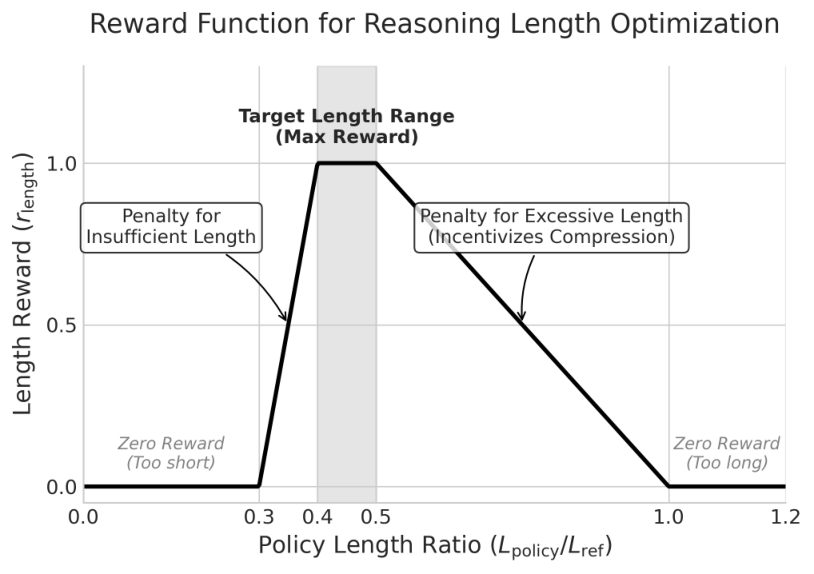
Length Reward (
The length reward
Correctness Reward (
where 1 indicates
Helpfulness Reward (
where 1 denotes
Group-relative advantages
We combine the three rewards into
Intuitively, this mechanism rewards responses that perform better than average within a mini-batch, making training more stable and less sensitive to absolute reward scales.
Policy optimization
The GRPO objective maximizes advantage-regularized returns:
where
Data and training setup
Datasets
We evaluate our approach on two distinct datasets, each containing 8,000 training and 400 test samples.
Tblive-E-Commerce QA
This dataset comes from real shopping streams. Each example keeps the viewer question, dialogue history, and structured product information retrieved for its intent. We use it because it preserves two problems we actually have to solve: comments arrive with omissions and conversational noise, while the reply still needs to stay inside the product evidence. Clean, self-contained questions would hide much of that difficulty.
MuSiQue
We also wanted a view beyond commerce, so we added the public multi-hop benchmark MuSiQue. One paragraph is deliberately insufficient to answer its questions; the model has to connect facts across material. We use the distractor setting, with roughly 10 documents per question and mostly irrelevant information. It tests evidence selection and combination under noise, complementing the live-room examples without pretending to measure exactly the same task. Results on it give us another place to check whether compression has removed useful reasoning.
Evaluation
Evaluation protocols differ across the test sets: On Tblive-E-Commerce QA, responses are assessed using the LLM-as-a-Judge framework from 3.2 for both correctness (C) and helpfulness (H). For MuSiQue, we follow standard evaluation practice using Exact Match (EM) and F1 scores to measure factual accuracy.
| Distillation Hyperparameters | GRPO Hyperparameters | ||
|---|---|---|---|
| Parameter | Value | Parameter | Value |
| Teacher model | DeepSeek-R1 | Rollouts per input ( | 8 |
| Base model | Qwen3-30B-A3B | Correctness weight ( | 0.4 |
| LLM judge model | DeepSeek-R1 | Helpfulness weight ( | 0.3 |
| Temperature ( | 0.7 | Length weight ( | 0.3 |
| Samples ( | 4 | Upper length ratio ( | 0.5 |
| Batch size | 2 | Lower length ratio ( | 0.4 |
| Learning rate | 1.5e-6 | Length tolerance ( | 0.1 |
| 0.01 | Learning rate | 2.5e-6 | |
| Batch size | 8 | ||
Training configuration
RFT trains on filtered corpus
Results
| Model / stage | Correctness | Helpfulness | Mean output tokens |
|---|---|---|---|
| Qwen3-30B-A3B base | 67.3 | 56.5 | 396 |
| + RFT | 81.3 | 77.0 | 353 |
| + RL without RFT | 87.5 | 90.0 | 152 |
| + RFT + RL | 92.3 | 96.8 | 153 |
| DeepSeek-R1 teacher | 89.0 | 75.0 | — |
Main results
We selected Qwen3-30B-A3B with RFT followed by RL for its combination of reply quality and generation cost on these datasets. The following comparisons separate the final results from each stage’s contribution.
On Tblive-E-Commerce QA, the final model reaches 92.3% correctness and 96.8% helpfulness; the DeepSeek-R1 teacher scores 89.0% and 75.0%. The student is about 22
MuSiQue EM/F1 reaches 53.5/67.2 against the teacher’s 41.2/57.0, while output falls from 807 to 473 tokens. The method also helps this cross-document task, though the size of the gain cannot be assumed for other domains.
We also tried the two stages on a dense 8B Llama backbone. DeepSeek-R1-Distilled-Llama-8B moves from 20.8% to 86.3% correctness and from 34.5% to 93.8% helpfulness, with TPR falling from 332 to 152. The benefit in these runs is therefore not confined to the MoE student. The starting models still differ, so their improvement sizes should be read separately.
Ablations
On Qwen3-30B-A3B, RFT alone raises correctness from 67.3% to 81.3% and helpfulness from 56.5% to 77.0%. TPR changes only from 396 to 353: answering improves while much of the teacher’s long reasoning remains. RL alone reaches 87.5% correctness, 90.0% helpfulness, and 152 TPR. RFT followed by RL reaches 92.3% and 96.8%, with 153 TPR. We kept both stages to learn useful answering behavior first, then improve its use within the generation budget. Length alone would miss the quality difference between the two short-output configurations.
Rejection sampling results
| Method | Correctness | Helpfulness |
|---|---|---|
| SFT | 81.0 | 72.0 |
| RFT | 81.3 | 77.0 |
Ordinary SFT from the same teacher, without rejection sampling, provides the filtering control. Correctness changes little; RFT improves helpfulness by 5.0 percentage points. Product facts may give imitation a clearer target, while clarity and understanding the viewer vary across teacher trajectories. Filtering selects for those differences. This explanation still depends on a calibrated Judge: rewarding length or a preferred style would pass that bias into the corpus. Data review therefore needs to examine which examples are admitted as well as how many are discarded.
Target reasoning length
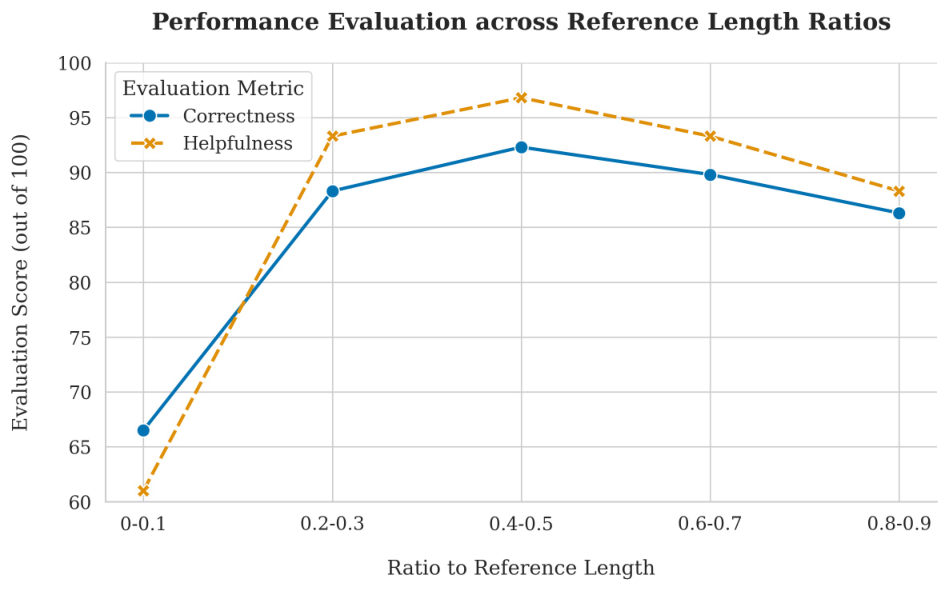
We varied
Reward ablations
| Rewards | Correctness | Helpfulness | TPR |
|---|---|---|---|
| 91.5 | 95.0 | 349 | |
| 87.3 | 72.3 | 145 | |
| 79.3 | 96.8 | 152 | |
| Full | 92.3 | 96.8 | 153 |
We remove
Adding length reward reduces output and improves correctness and helpfulness in these ablations. Without helpfulness, for example with
MoE model choice
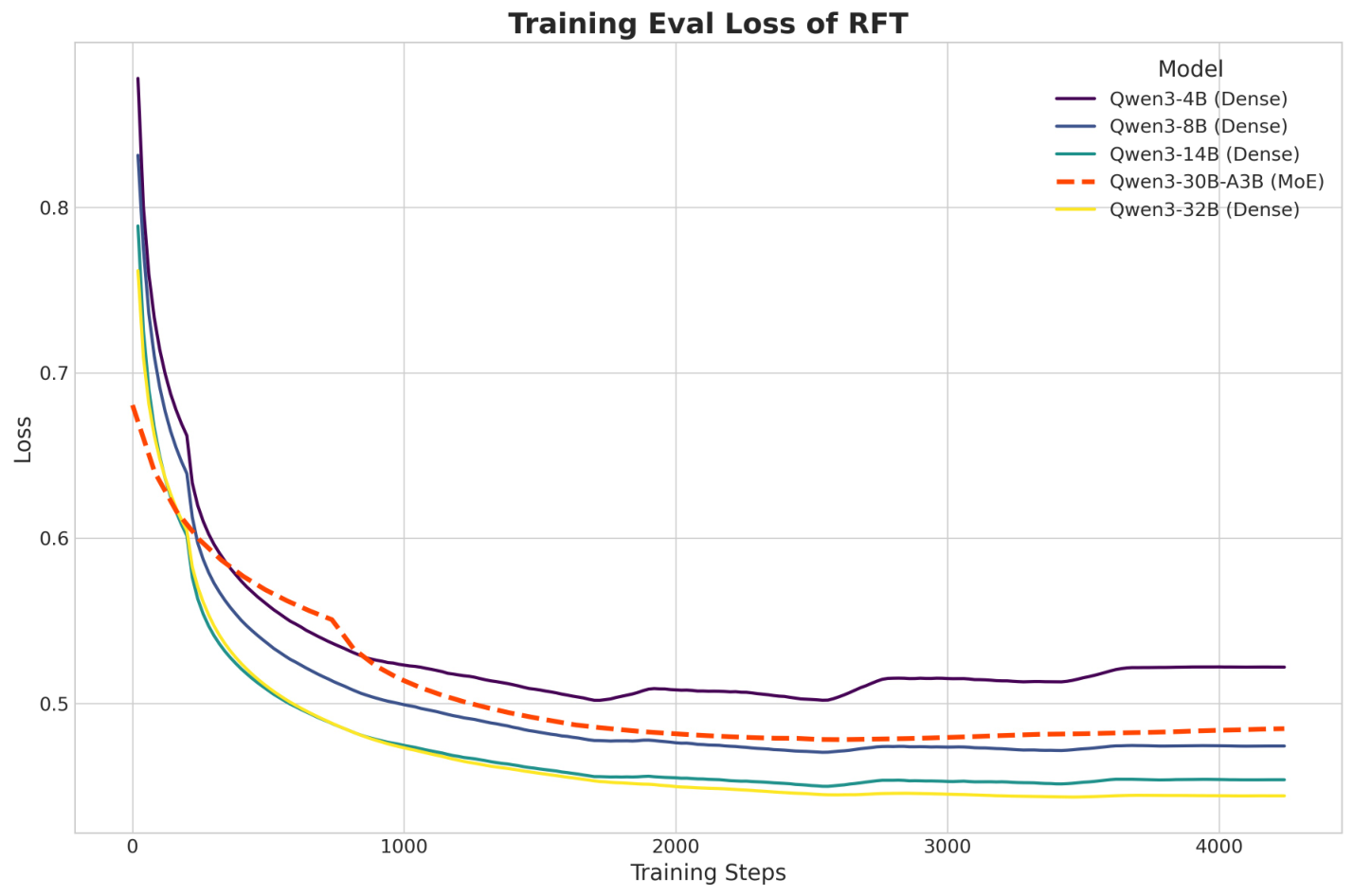
We compared the MoE student with dense models from 4B to 32B as well. Our selected Qwen3-30B-A3B has 30B total parameters and 3B active per inference. On this task, it approaches the quality of the larger dense comparison at about 7.5B, with lower inference cost, and performs better than the smaller dense alternative. That quality–cost combination made it a sensible starting point for our deployment work. It is a choice for this workload and latency budget, rather than a conclusion that MoE is always the most efficient architecture.
Case: missing product evidence
The viewer asks for a cool-only air conditioner, while all three retrieved products support both heating and cooling. The missing match cannot be repaired through fluent generation. The model must not relabel a listed product or invent an additional item.
The paper compares RFT and LiveThinking traces for this request. Both recognize the mismatch. The longer RFT trace repeatedly revisits the absence of a matching product and how to phrase a polite reply; the compressed trace reaches the same product-type decision more directly. Repeated checks and wording deliberation are plausible compression targets, while the check against the requested constraint remains necessary.
The final reply still deserves a separate audit. Suggestions about customization, non-standard models, or alternative inventory require evidence of their own. A correct internal diagnosis does not guarantee that every sentence in the generated reply is supported. Reward and length optimization improve behavior without replacing claim-level verification.
For a useful replay, inspect the question, retrieved material, reasoning, and final response together. An evasive answer points toward helpfulness; unsupported suggestions point toward factual grounding; a longer trace with unchanged quality points toward the reasoning budget. This gives a concrete failure category rather than the vague diagnosis that the model is insufficiently capable.
Training workflow
A training request contains the viewer question, dialogue history, and retrieved product evidence. The teacher may sample several trajectories, but producing a plausible answer is not sufficient for inclusion. Filtering asks whether the final claims are grounded and whether the response actually helps the viewer. A request for which every candidate fails can be omitted rather than turned into low-quality supervision.
RFT therefore differs from ordinary SFT mainly in the admission rule for demonstrations. Both update the student through supervised learning; rejection sampling makes evaluation part of data production. Fewer examples can still provide a better signal if the discarded examples contain hallucination, evasive answers, or unproductive reasoning. That benefit depends on the Judge: a preference for verbosity can contaminate the filtered corpus as easily as the original teacher can.
During RL, two shortcuts require attention. A correctness-only policy can avoid mistakes by saying very little. A brevity-only policy can stop before checking necessary conditions. Helpfulness and factual correctness constrain the pressure to shorten. The acceptable length interval leaves room for different question difficulty: a price lookup and a two-product specification comparison should not be forced into the same minimum budget.
From evaluation to deployment
The industrial and public benchmarks serve different purposes and use different scoring protocols. Judge–human agreement is a check on the evaluator, not the answer model’s accuracy. Keeping those quantities separate helps diagnose a suspicious reward increase: the policy may have improved, or it may have learned a style the evaluator favors.
The production A/B test also has its own baseline: the previous 14B dense deployment, rather than the Qwen3 base-model ablations in the offline table. Business improvements observed in July 2025 should be read within that serving configuration and traffic experiment. They complement the offline results without turning them into a universal conversion claim.
Finally, fewer output tokens reduce only part of service latency. Queueing, prefill, retrieval, speech synthesis, and broadcast scheduling still matter. Measure the complete path and its tail latency, and check that shorter reasoning has not increased unsupported product claims or unnecessary refusals. The useful outcome is a reliable spoken answer delivered in time.